
Mission
Spotlight on Africa
Spotlight on Africa (SoA) empowers some of Africa’s poorest communities to become self-reliant and sustainable through a holistic, integrated approach. Its UK volunteers collaborate closely with local partners to deliver clean water, dignified sanitation, healthcare, education, and economic opportunities. By providing training, skills development, and access to income generation, SoA helps break the cycle of poverty and build lasting change.
Sponsoring P&G Alumni
Sponsoring Alum: Will Treasure
3 years in Manufacturing/PSO, Manchester, UK
Will has served on the Spotlight on Africa Board for the past four years, personally raising $50,000 through sponsored cycling events, speaking at fundraising dinners and generally raising the profile of its work.
In his letter of support, Will tells us what drives his interest in Spotlight; “I believe deeply that we have a moral responsibility to help those in greatest need, wherever they may be. What drew me to Spotlight on Africa is its unique model—highly efficient, community-led, and deeply impactful. In the UK, we operate entirely through volunteers. We have no paid or fundraising staff, which allows us to direct 95% of the funds we raise straight to Uganda. Our UK team provides strategic direction and governance, while the day-to-day work is led by an eight-member local management team in Uganda, overseen by a Ugandan supervisory board. Together, they manage a school, a health clinic, a maternity center, and a jobs and skills training program that collectively employ over 60 local staff. Spotlight on Africa is delivering real, tangible change in a community that is often overlooked.”
The SoA Vocational Training Program
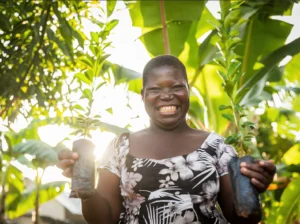
Mbale is a remote town of over 100,000 people in eastern Uganda, near the Kenyan border—more than five hours from Kampala. Despite its size, it remains one of the most underserved regions in the country, with limited support from aid agencies. The population is extremely poor, even by national standards, and includes many refugees, former child soldiers, and displaced families who fled decades of conflict in Northern Uganda and South Sudan. Over half the population is under the age of 16. The objective of the program is to provide skills development for a period of 10 months of training followed by a graduation when each graduate is given a start-up pack to enable them to start their own businesses or become employed. In this way SoA is transforming lives through economic empowerment—one of SoA’s four core pillars—by equipping individuals with practical, income-generating skills. Our vocational training programs in carpentry, tailoring, and farming are helping men, women, and in particular our Community Health Promoters (CHPs) move from dependency to self-sufficiency.
2025 Grant
The $25,000 PGAF grant will fund the training costs of the carpentry, tailoring, farming and hairdressing apprentices for calendar 2026. Costs range from wood materials for the carpenters to fabrics for the tailors to planting media/seeds for the farmers as well as staff/trainer expenses. There are no set-up costs or timeline as the program has run in prior years, the training team is in place, and locations are ready to go. Twenty-five apprentices in carpentry, 42 in tailoring, 44 in farming and 12 in hairdressing will create 60 employment opportunities.
Success Story
Story provided by Grant Champion, Will Treasure:
 When I visited Mbale, Uganda in 2022 I followed up with a number of graduates to see for myself the effectiveness of our training. The first carpentry graduate I visited was an older man, in his early fifties. He proudly showed me the house that he had built, using the skills he had learned. It was a single story, 200 sq. ft. floorspace, which is large by the standards of his local community, and it was enough for his family. Next door he had built a second house of similar size which he let out to another family, producing a small income for him. He had a number of goats tethered nearby and was clearly relatively prosperous.
The second graduate I met was only 22, but he already had a small workshop in his house and employed 3 other graduates and 2 unskilled men making household furniture which he sold locally. These unskilled men were hoping to be one of the next intake of apprentices. I was amazed at his business ability, to be employing other local men at such a young age.
I also visited one single mother who after our sewing training had gotten a job at the local industrial park, making furniture covers. On her wages of $2 per day, she was able to support herself, her four-year old son and her parents who looked after her son while she worked. She was ill, emaciated, and destitute after her husband left her and when she started her training. Now she looked well. Her life was hard, she had to work 7 days per week, 10 hours per day and had an hour walk each way to get to the factory, but it was so much better than the life she had before our training.”